My-CSAPP
Machine Level Programming IV: Data & V: Advanced Topics
Introduction
在之前的课程中,我们详细介绍了 C 语言中一些基本类型的表示:
- 整数(不同位数的整数,有符号和无符号)
- 浮点数
- 布尔值(一种特殊的整数)
- Char & Strings
- 指针类型
高级编程语言(包括 C)都需要更加复杂的数据结构来进行表示和建模,例如列表、结构体等等。如此之类复杂的、可动态变化的复合数据类型在程序运行和汇编语言中的表示更加的复杂。
- Arrays
- Structs
- Floating Points
Array
T A[L]:
- T is thr array of data type
- the length of the array: L
在栈上连续分配 L * sizeof(T) bytes。
数组就是指针!,数组变量在 C 代码中可以被用作一个
T*类型的指针。
#include <stdio.h>
#define ZLEN 6
typedef int zip_dig[ZLEN];

void show_pointer() {
  int arr[10] = {1, 2, 3, 4, 5, 6, 7, 7, 8, 9};
  printf("%p\n", arr);
  printf("%p\n", arr + 1);

  char arr_2[10] = {'1', '2', '3'};
  printf("%p\n", arr_2);
  printf("%p\n", arr_2 + 1);

  //   or another methods
  zip_dig cmu = {1, 5, 2, 1, 3};
  printf("%p\n", cmu);
  printf("%p\n", cmu + 1);

  //   this will cause damage
  //   arr += 1;
}

int main() {
  show_pointer();
  return 0;
}
0x16d8d1dd0
0x16d8d1dd4
0x16d8d1dc0
0x16d8d1dc1
0x16d8d1da0
0x16d8d1da4
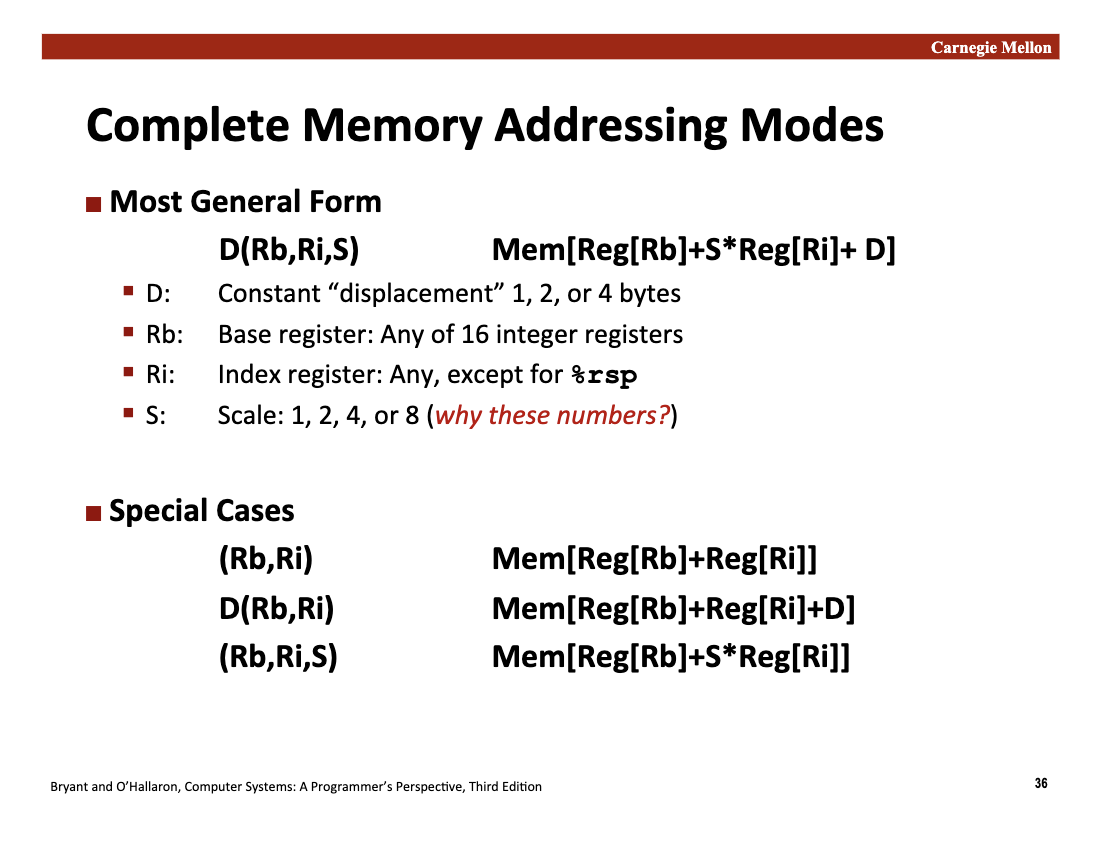
可以看到 arr_2 在栈内存中的地址低于 arr,但是在指针变量内部,顺序又是从高位到低位的,因此可以发现数组在程序运行时的处理是比较特殊的。回忆一下在第五讲讲到的 Memory Addressing Modes:
D(Rb, Ri, S): Mem[Reg[Rb] + S*Reg[Ri] + D]
S: 1,2,4,8 (扩展寄存器支持特定的后缀寻址方式)- Rb: Base register
- Ri: Index register
很显然,在数组中内存的访问非常方便使用这种模式进行:
#define ZLEN 6
typedef int zip_dig[ZLEN];

int get_digit(zip_dig z, int digit) { return z[digit]; }
	.file	"memory_addressing_modes.c"
	.text
	.globl	get_digit
	.type	get_digit, @function
get_digit:
.LFB0:
	.cfi_startproc
	movslq	%esi, %rsi
	movl	(%rdi,%rsi,4), %eax
	ret
	.cfi_endproc
.LFE0:
	.size	get_digit, .-get_digit
	.ident	"GCC: (GNU) 15.2.0"
	.section	.note.GNU-stack,"",@progbits
movl (%rdi,%rsi,4), %eax 这一条指令代表从 %rdi(第一个输入参数,指针变量)开始作为 base register,然后以 4 字节为基本单位索引向后移动 %rsi 个单元,并取址读取值,存储到寄存器 %eax 中(函数的返回值)
再看一个更难的例子:
void zincr(zip_dig z) {
  size_t i;
  for (i = 0; i < ZLEN; i++) {
    z[i]++;
  }
}
zincr:
.LFB1:
	.cfi_startproc
	movl	$0, %eax
	jmp	.L3
	.p2align 5
.L4:
	leaq	(%rdi,%rax,4), %rcx
	movl	(%rcx), %esi
	leal	1(%rsi), %edx
	movl	%edx, (%rcx)
	addq	$1, %rax
.L3:
	cmpq	$5, %rax
	jbe	.L4
	ret
	.cfi_endproc
%rax寄存器始终进行 for 循环下标 i 的读取和更新leaq (%rdi,%rax,4), %rcx: 读取对应数组下标的地址(注意 mov 和 lea 的指令功能不同,leaq 不会从内存中读取具体的值)movl (%rcx), %esi: 从内存地址 %rcx 取出值,存入 %esi (即 val = arr[i])leal 1(%rsi), %edx: 利用 leal 计算 %rsi + 1,结果存入 %edxmovl %edx, (%rcx): 将加 1 后的值写回内存地址 %rcx (即 arr[i] = val + 1)- 这里的自增操作貌似显的有点多余,实则也是后置++的特性,需要返回自增之前的值,因此需要使用单独一个变量进行存储。
Nested Arrays
T A[R][C]: 2D data array of data typeT- R rows, C columns
-
Type
Telement requiresKbytes. - Total size: R * C * K
在内存中的存储结构和正常的一样。
\[A+i*(C*K)+j*K = A+(i*C+j)*K\]#include <stdio.h>
#define PCOUNT 4
#define ZLEN 6
typedef int zip_dig[ZLEN];
zip_dig pgh[PCOUNT] = {
{1, 5, 2, 0, 6}, {1, 5, 2, 1, 3}, {1, 5, 2, 1, 7}, {1, 5, 2, 2, 1}};
int *get_pgh_zip(int index) { return pgh[index]; }
int get_pgh_digit(int index, int dig) { return pgh[index][dig]; }
get_pgh_zip:
.LFB11:
	.cfi_startproc
	movslq	%edi, %rdi
	leaq	(%rdi,%rdi,2), %rax
	leaq	pgh(,%rax,8), %rax
	ret
	.cfi_endproc
.LFE11:
	.size	get_pgh_zip, .-get_pgh_zip
	.globl	get_pgh_digit
	.type	get_pgh_digit, @function
get_pgh_digit:
.LFB12:
	.cfi_startproc
	movslq	%esi, %rsi
	movslq	%edi, %rdi
	leaq	(%rdi,%rdi,2), %rax
	leaq	(%rsi,%rax,2), %rax
	movl	pgh(,%rax,4), %eax
	ret
	.cfi_endproc
.LFE12:
	.size	get_pgh_digit, .-get_pgh_digit
	.globl	pgh
	.data
	.align 32
	.type	pgh, @object
	.size	pgh, 96
- In
get_pgh_zipfunction:leaq (%rdi,%rdi,2), %rax: rax = 3 * rdileaq pgh(,%rax,8), %rax: $\text{rax} = \text{pgh} + (\text{rax} \times 8)$- 两行计算整体进行:
rax = pgh + 24 * rdi, 24 = 38= 46!- 不得不感叹,聪明的编译器
- In
get_pgh_digitfunction:leaq (%rdi,%rdi,2), %rax:rax = 3*rdileaq (%rsi,%rax,2), %rax:rax = rsi + rax*2- 合起来:
rax = rsi + 6* rdirdi对应第一个参数 indexrsi对应第二个参数 dig
movl pgh(,%rax,4), %eax: eax 的值是pgh + 4*(rsi + 6*rdi)的地址上的数取值得到的结果。
Multi-Level Array
在生成一个 Nested Array 的时候,整个数组的元素都存储在栈上的一段连续空间,可以快速通过索引计算得到,在上文的汇编中也展示了使用 leap 等汇编指令进行内存区域的快速访问。
但是如下的声明方式存在差异:
#include <stddef.h>
#include <stdio.h>
#define PCOUNT 4
#define ZLEN 6
#define UCOUNT 3
typedef int zip_dig[ZLEN];

zip_dig pgh[PCOUNT] = {
    {1, 5, 2, 0, 6}, {1, 5, 2, 1, 3}, {1, 5, 2, 1, 7}, {1, 5, 2, 2, 1}};

zip_dig cmu = {1, 5, 2, 1, 3};
zip_dig mit = {0, 2, 1, 3, 9};
zip_dig ucb = {9, 4, 5, 2, 0};

int *univ[UCOUNT] = {mit, cmu, ucb};
// univ 也是一个二维数组(二维指针),在这里表示成一个一维指针的数组

int *get_pgh_zip(int index) { return pgh[index]; }

int get_pgh_digit(int index, int dig) { return pgh[index][dig]; }

int get_univ_digit(size_t index, size_t digit) { return univ[index][digit]; }
univ 是一个一维数组的指针,因此三个指针变量存储在连续的内存中,但是三个指针指向的内容存储在不同的内存区域中。
get_univ_digit:
.LFB13:
	.cfi_startproc
	movq	univ(,%rdi,8), %rax
	movl	(%rax,%rsi,4), %eax
	ret
	.cfi_endproc
movq univ(,%rdi,8), %rax将对应的一维数组中元素读取出来,注意这里是movq会从内存中取值。- 取出来的值仍然是一个地址!(因为这个数组的元素是一个 int 类型的指针),接下来再读取 rsi 中的第二个函数输入参数,读取到最终的 digit。
对于 Multi-Level Array,需要多次的解引用操作。
VLA
在 C99 中,引入了变长数组 Variable Length Array,允许数组的长度在运行时确定而不是在编译时确定。
#include <stddef.h>

int vec_ele(size_t n, int a[n][n], size_t i, size_t j) { return a[i][j]; }
vec_ele:
.LFB0:
	.cfi_startproc
	imulq	%rdx, %rdi
	leaq	(%rsi,%rdi,4), %rax
	movl	(%rax,%rcx,4), %eax
	ret
	.cfi_endproc
rax = rsi + 4* (rdi * rdx)- rdx is
i, and rdi isn - rax 读取了第一个索引对应的地址
- rdx is
movl (%rax,%rcx,4), %eax: 加上了第四个参数 rcx 并读取,最终读取到对应的内存位置并取得对应的值,存储在 rax 寄存器中返回。
Structs
- 结构体中的数据存储在一段连续的内存块中 (block of memory)
- 编译器会跟踪每个数据的起始位置(编译时完成)
#include <stddef.h>
struct rec {
  size_t i;
  int a[4];
  struct rec *next;
};

int get_a(struct rec *r, size_t idx) { return r->a[idx]; }

int *get_ap(struct rec *r, size_t idx) { return &(r->a[idx]); }
	.file	"structs.c"
	.text
	.globl	get_a
	.type	get_a, @function
get_a:
.LFB0:
	.cfi_startproc
	movl	8(%rdi,%rsi,4), %eax
	ret
	.cfi_endproc
.LFE0:
	.size	get_a, .-get_a
	.globl	get_ap
	.type	get_ap, @function
get_ap:
.LFB1:
	.cfi_startproc
	leaq	8(%rdi,%rsi,4), %rax
	ret
	.cfi_endproc
.LFE1:
	.size	get_ap, .-get_ap
	.ident	"GCC: (GNU) 15.2.0"
	.section	.note.GNU-stack,"",@progbits
get_a函数会根据输入参数的索引取到特定的内存位置并取值movl 8(%rdi,%rsi,4), %eax: 取出的目标地址是rdi + 8 + 4* rsi- 根据定义的顺序,第一个类型是一个占 8 个字节的 size_t 变量
- rdi 代表第一个输入参数,即地址
- rsi 代表第二个输入参数,即数组 a 内部的偏移量,因此乘 4(是 int 类型的变量)
get_ap:leaq 8(%rdi,%rsi,4), %rax一模一样的操作,只不过直接取地址存入寄存器,而不是使用 movel 取出对应地址上的值。
Linked List
#include <stddef.h>
struct rec {
  size_t i;
  int a[4];
  struct rec *next;
};

void set_val(struct rec *r, int val) {
  while (r) {
    int i = r->i;
    r->a[i] = val;
    r = r->next;
  }
}
	.file	"linked_list.c"
	.text
	.globl	set_val
	.type	set_val, @function
set_val:
.LFB0:
	.cfi_startproc
	jmp	.L2
	.p2align 4
.L3:
	movslq	(%rdi), %rax
	movl	%esi, 8(%rdi,%rax,4)
	movq	24(%rdi), %rdi
.L2:
	testq	%rdi, %rdi
	jne	.L3
	ret
	.cfi_endproc
.LFE0:
	.size	set_val, .-set_val
	.ident	"GCC: (GNU) 15.2.0"
	.section	.note.GNU-stack,"",@progbits
- 循环的判断是判断输入参数 r 是否为 0:
testq %rdi, %rdi - 循环内部的代码在 L3:
- 从寄存器 rdi 中的地址读取一个数,存入 rax 中
- 然后将存储在 esi 中的值写入
8(%rdi,%rax,4):a[i] - next 指针的位置移位是 24 位,因此最后一步是在做 next 指针的更新,把移位 24 的地址进行取值(取出来的值仍然是一个地址)更新给当前的 rdi 寄存器
Alignment
在大多数现代系统(如 x86-64)中,对齐遵循以下两个基本原则:
- 成员对齐:每个成员的起始地址必须是它自身大小的倍数。
- char (1 字节):可以放在任何地址。
- short (2 字节):地址必须是 2 的倍数。
- int / float (4 字节):地址必须是 4 的倍数。
- double / long / 指针 (8 字节):地址必须是 8 的倍数。
- long double (16 字节):地址必须是 16 的倍数。
- 整体对齐:整个结构体的总大小,必须是内部最大成员大小的倍数(为了保证在结构体数组中,每个元素的成员都能对齐)
对于结构体组成的数组,每一个结构体需要保证对齐!
Why Alignment?
- CPU 和主存通过总线读取数据,不是逐字节读取的,而是每次读取一段数据块。对齐可以让 CPU 不需要读取两次数据来获得一个数据的值。
#include <stdio.h>

struct a {
  short i;
  float v;
  short j;
} a_va;

struct b {
  short i;
  short j;
  float v;
} b_va;

struct c {
  char c;
  int i;
  char d;
} c_va;

struct d {
  int i;
  char c;
  char d;
} d_va;

int main() {
  printf("The length of structure a: %ld\n", sizeof(a_va));
  printf("The length of structure b: %ld\n", sizeof(b_va));
  printf("The length of structure c: %ld\n", sizeof(c_va));
  printf("The length of structure d: %ld\n", sizeof(d_va));
}
The length of structure a: 12
The length of structure b: 8
The length of structure c: 12
The length of structure d: 8
可以看到,在定义结构体的时候,不同变量的摆放顺序会影响内存使用的大小!
Unions
- 结构体为每一个字段分配连续内存并对齐
- Unions: 只为最大的变量分配内存
#include <stdio.h>
typedef union {
  float f;
  unsigned u;
} bit_float_t;

float bit_2_float(unsigned u) {
  bit_float_t arg;
  arg.u = u;
  return arg.f;
}

unsigned float_2_bit(float f) {
  bit_float_t arg;
  arg.f = f;
  return arg.u;
}

int main() {
  // both for 4 bytes
  printf("The length of float: %lu\n", sizeof(float));
  printf("The length of unsigned: %lu\n", sizeof(unsigned));

  float num_1 = 0.01;
  unsigned num_2 = 20;

  printf("Casting directly: %u\n", (unsigned) num_1);
  printf("Casting directly: %f\n", (float) num_2);
  printf("Casting using float_2_bit: %u\n", float_2_bit(num_1));
  printf("Casting using bit_2_float: %f\n", bit_2_float(num_2));
  return 0;
}
- 直接的类型转换是 Value conversion (numeric value is converted)
- 但是使用 Union 会保证 bit-level 的类型不变!因此不可以当做 casting 用!
Floating Points
Skip this part for this time…
Memory Layout
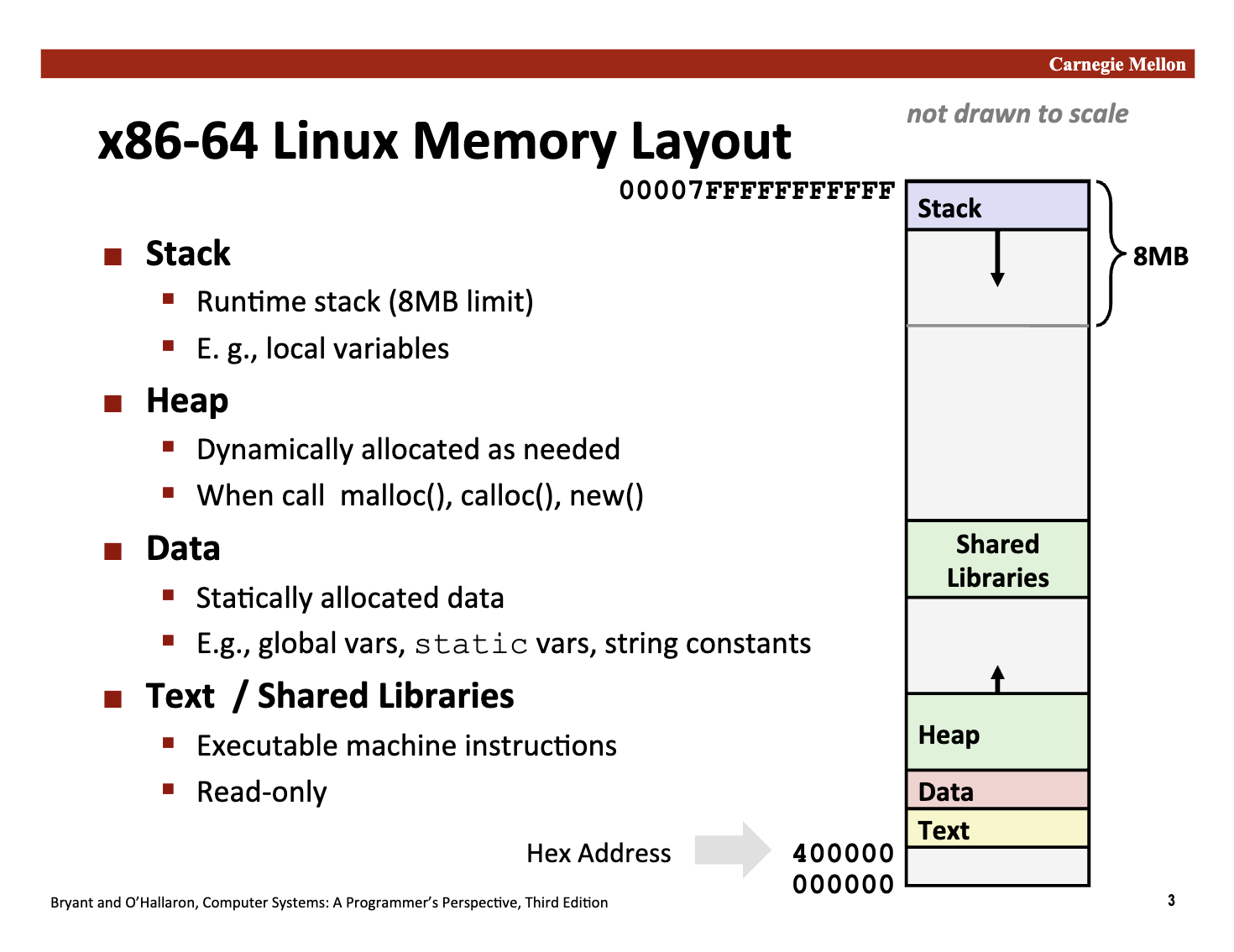
- Text (代码段)
- 位置: 内存的最底部(靠近地址 400000)。
- 内容: 存储编译后的可执行机器指令。
- 特性: 通常是只读的,防止程序在运行时意外修改自己的代码。
- Data (数据段)
- 内容: 存储静态分配的数据。
- 包含: 全局变量(Global variables)、静态变量(Static variables)以及字符串常量。
- 注意: 在更细致的分类中,它通常分为 .data(已初始化的变量)和 .bss(未初始化的变量)。
- 因此声明为全局变量不是存储在栈上,往往可以开更大的数组。
- Heap (堆)
- 内容: 用于动态内存分配。
- 触发方式: 当你在程序中调用 malloc()、calloc() 或 C++ 中的 new 时,内存会从这里分配。
- 生长方向: 如图中箭头所示,堆是向上(向高地址)生长的。
- Shared Libraries (共享库)
- 内容: 存储程序调用的外部库(如标准 C 库 libc)。
- 作用: 多个进程可以共享同一份物理内存中的库代码,从而节省空间。
- Stack (栈)
- 位置: 内存的最顶部(靠近地址 00007FFFFFFFFFFF)。
- 内容: 存储局部变量、函数参数和返回地址。
- 特性: * 生长方向: 向下(向低地址)生长。
- 限制: 图中注明了 8MB limit,这是典型的 Linux 默认栈大小。如果递归过深或局部变量过大,就会导致著名的“栈溢出”(Stack Overflow)。
- 栈在内存的最顶端,生长的方向是向下生长
- 堆内存在内存的最低端,生长的方向是向上生长。(malloc)
Buffer Overflow
不正确的内存引用操作会导致非常严重的后果,例如下面的 memory bug,对结构体中数组的不正确访问影响了结构体中其他变量的值。(并且没有任何的警告和报错信息)
#include <stdio.h>

typedef struct {
  int a[2];
  double d_1;
  double d_2;
} struct_t;

struct_t fun(int i) {
  // volatile 关键词声明会禁止编译器进行优化
  volatile struct_t s;
  s.d_1 = 3.14;
  s.d_2 = 4.33;
  s.a[i] = 1073741824;
  return s;
}

int main() {
  printf("The Size of struct_t: %lu\n", sizeof(struct_t));
  for (int i = 0; i <= 6; i++) {
    printf("Current (i=%d), d_1: %.10f, d_2: %.10f\n", i, fun(i).d_1, fun(i).d_2);
  }
  return 0;
}
The Size of struct_t: 24
Current (i=0), d_1: 3.1400000000, d_2: 4.3300000000
Current (i=1), d_1: 3.1400000000, d_2: 4.3300000000
Current (i=2), d_1: 3.1399998665, d_2: 4.3300000000
Current (i=3), d_1: 2.0000006104, d_2: 4.3300000000
Current (i=4), d_1: 3.1400000000, d_2: 4.3299989700
Current (i=5), d_1: 3.1400000000, d_2: 2.0000009918
Current (i=6), d_1: 3.1400000000, d_2: 4.3300000000
栈溢出的行为是在汇编层面发生的,因此非常危险,也更难察觉,例如,黑客可以通过栈溢出的手段修改其他部分的内存空间,实现向恶意分支的跳转操作。
例如,一个已经废弃的 *gets 函数,如果用户输入的长度超过了给定缓冲区的长度,额外超出的部分会覆盖缓冲区之外的数据,造成运行问题。
#include <stdio.h>
char *unsafe_gets(char *dest) {
  // * 工作指针 p 指向缓冲区的起始位置

  int c = getchar();
  char *p = dest;
  while (c != EOF && c != '\n') {
    *p++ = c;
    // * 先自增、但是解引用的是自增之前的地址
    c = getchar();
  }
  *p = '\0';
  return dest;
  // * 最终 dest 指向的是缓冲区的起始位置的指针
}

char *safe_gets(char *dest, int size) {
  int c = getchar();
  char *p = dest;
  int count = 0;
  // 增加了一个条件:count < size - 1
  // * 避免读入的字符超过缓冲区
  while (count < size - 1 && c != EOF && c != '\n') {
    *p++ = c;
    count++;
    c = getchar();
  }
  *p = '\0';
  return dest;
}

int main(){
    char buffer[16];
    // ! unsafe methods
    printf("%s\n", unsafe_gets(buffer));

    // safe methods
    printf("%s\n", safe_gets(buffer, sizeof(buffer)));
    return 0;
}
Examples
- The original Internet Worm (1988)
- IM War
- Worms and Viruses
Avoid Overflow Problems
fgets
fgetsinstead ofgetsstrncpyinstead ofstrcpy- Do not use
scanfwith%sconversion specifications- Use
fgetsto read the strings %ns
- Use
#include <stdio.h>
#include <string.h>

#define MAX_BUF 16

int main() {
  char input_id[MAX_BUF];
  char bio[MAX_BUF];
  char secure_backup[8];

  printf("Enter a String with maximum length of %d: ", MAX_BUF - 1);
  scanf("%15s", input_id);

  // * 清除缓冲区中的回车符
  int c;
  while ((c = getchar()) != '\n' && c != EOF)
    ;

  printf("Enter another string with maximum length of %d: ", MAX_BUF - 1);
  if (fgets(bio, sizeof(bio), stdin) != NULL) {
    bio[strcspn(bio, "\n")] = '\0';
  }

  printf("Using strncpy...\n");
  strncpy(secure_backup, bio, sizeof(secure_backup) - 1);
  secure_backup[sizeof(secure_backup) - 1] = '\0';

  printf("String 1: %s\n", input_id);
  printf("String 2: %s\n", bio);
  printf("String 3: %s\n", secure_backup);

  return 0;
}
这些更加安全的标准库用法可以保证读取输入&字符串指针的时候不会产生栈溢出!
Randomized Stack Offsets
ASLR: Address Space Layout Randomization
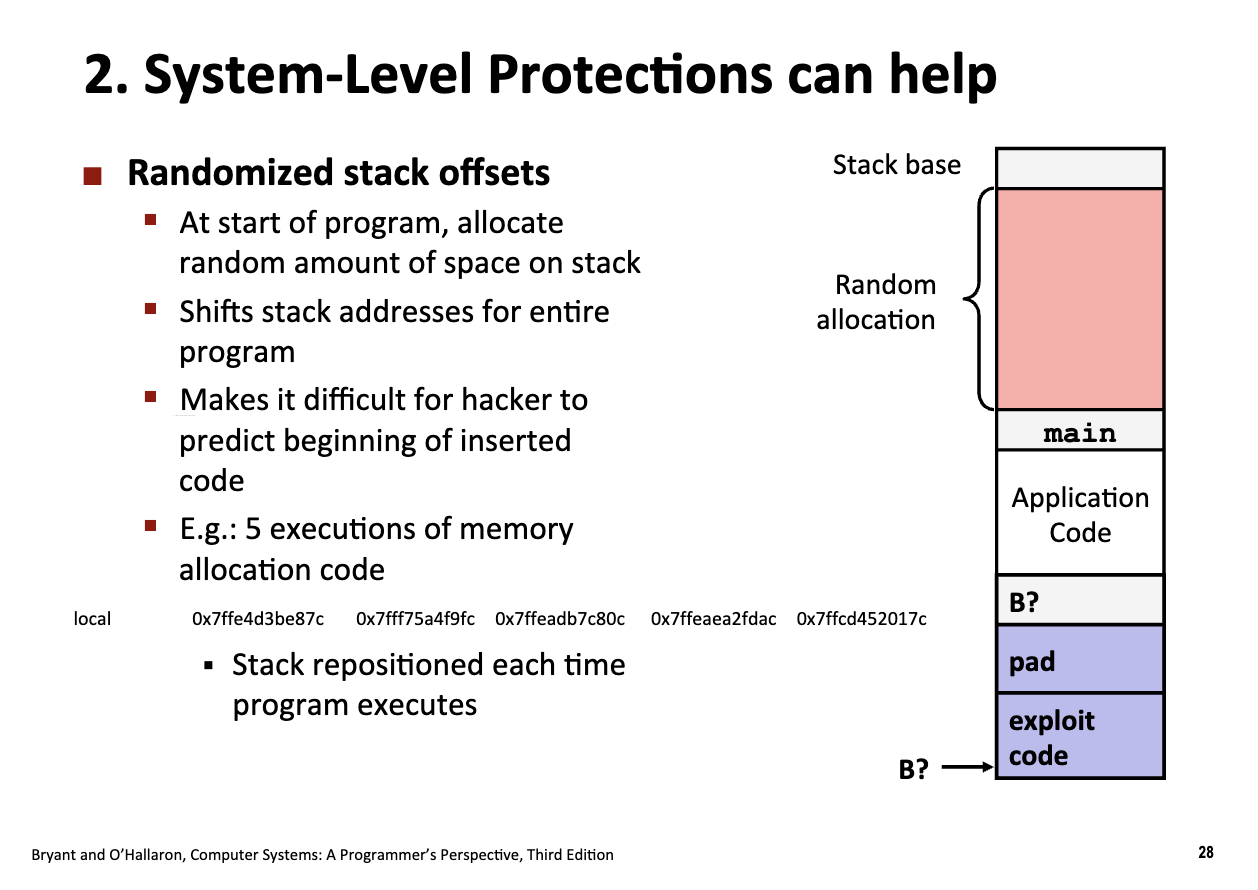
代码注入攻击首先需要了解缓冲区在内存中的起始地址,因此现代编译器引入了随机化操作,让黑客无法直接定位缓冲区。无法进行注入攻击。
每次程序启动时,操作系统都会在栈的最顶端随机分配一段空余空间(Random allocation)。这会导致整个栈的所有地址向下平移。同一个局部变量 local 的地址从 0x7ffe… 变成了 0x7fff…。每次运行,地址都在变。
Data Execution Prevention (DEP)
-
在老旧的处理器架构中,内存通常只区分“只读”或“可写”。只要是 CPU 能读到的内存区域,它就默认可以执行其中的指令。这意味着攻击者只要把代码写进栈里,就能运行它。
-
现代解决方案 (X86-64): 引入了明确的 “执行 (Execute)” 权限。硬件现在可以给内存贴上标签:
- 代码区: 可读、可执行,但不可写。
- 数据/栈区: 可读、可写,但不可执行。
即便攻击者成功地把恶意代码(图中蓝紫色部分)塞进了栈里,当 CPU 试图去运行这块区域的内容时,硬件会立刻发现“这块区域禁止执行”,从而强制关闭程序,防止攻击成功。
内存的执行权限
和文件的执行权限类似,内存的执行权限会控制 CPU 执行某块内存区域中的代码,例如栈内存、堆内存是不可执行的,防止黑客恶意使用栈溢出进行工具、注入危险程序。
- text 等存储程序机器执行代码的位置是可执行的。
Stack Canary Protections
当你编译程序并开启了保护(如 -fstack-protector)时,编译器会在每个“危险”函数的栈帧中插入一个随机生成的秘密数值。这个值被放置在 局部变量(如你的 buffer) 和 返回地址(Return Address) 之间。
一旦 Buffer Overflow 发生,金丝雀随机数会被覆写,此时程序会抛出 Abort Trap。如果保证严格的独立性,每一个栈帧中间都需要加上金丝雀保护(夹在 Caller Frame 的 Return Address 和旧的栈帧指针 与 Callee Frame 的局部变量存储(缓冲区)之间。
Canary 通常为 8 bytes,是一个 long 类型的随机数。
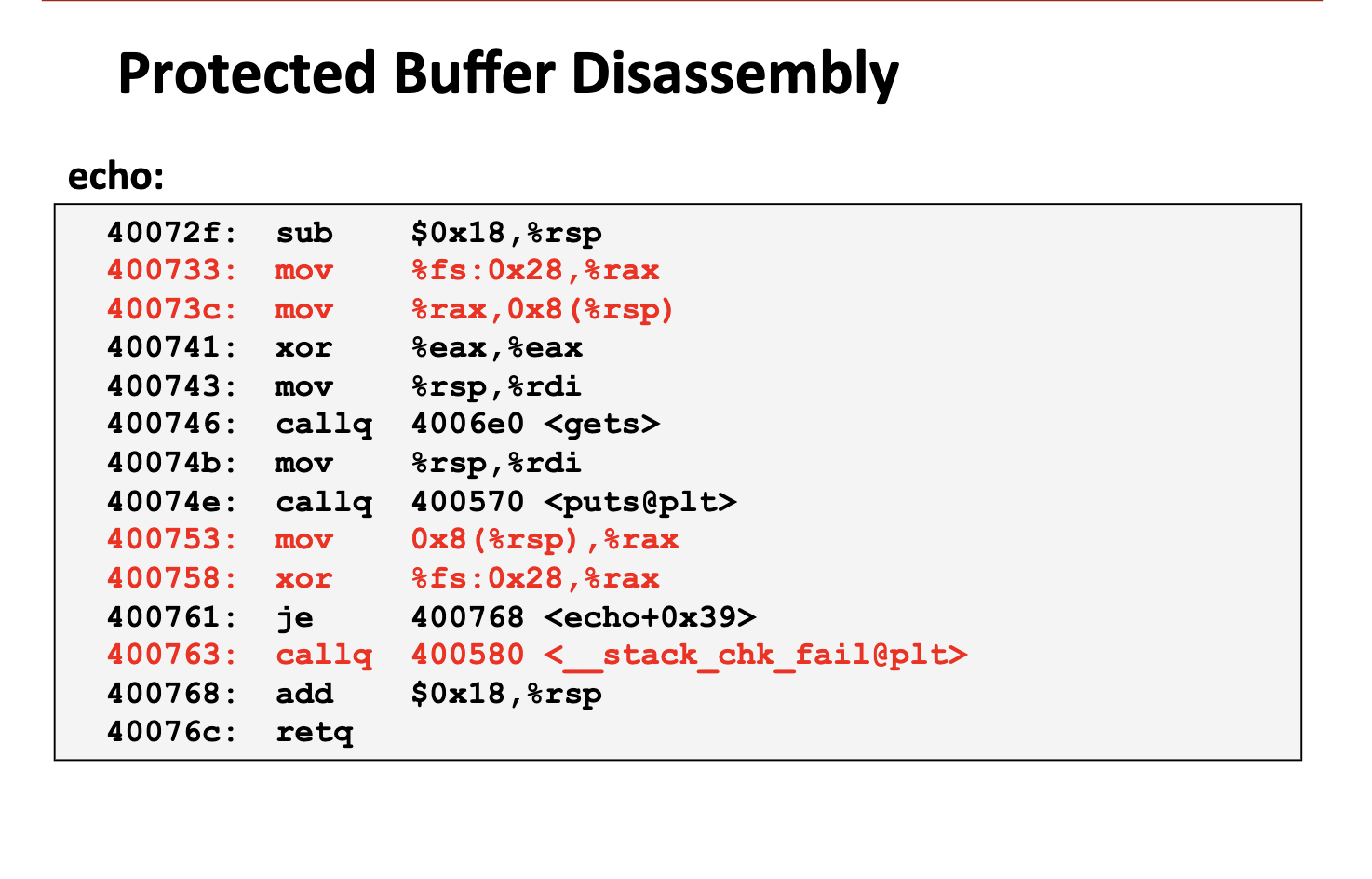
mov %fs:0x28, %rax: 从线程局部存储(TLS)中读取一个随机值(Canary),存入 %rax 寄存器。%fs:0x28是一个特殊的内存地址,存放着当前线程的 Stack Canary 值。mov %rax, 0x8(%rsp): 保存 canary 到栈上mov 0x8(%rsp), %rax: 读取 canary 值xor %fs:0x28, %rax: 与原始的 canary 值进行异或比较。
这会保证 caller 的下一个地址不会被篡改,避免程序的控制流被恶意篡改。
Return-Oriented Programming Attacks
- 不注入代码,而是使用现有代码,得到系统权限。(同样利用栈溢出)