My-CSAPP
Lecture 4 Floating Points
Fractional Floating Numbers
在小数部分,和十进制一样,二进制数也可以表示小数部分。
对于一个任意的二进制数 $N$,如果它有 $n$ 位整数和 $m$ 位小数,可以写成:
\[(d_{n-1}d_{n-2}\dots d_1d_0 . d_{-1}d_{-2}\dots d_{-m})_2\]其对应的十进制数值 $V$ 的求和形式为:
\[V = \sum_{i=-m}^{n-1} d_i \cdot 2^i\]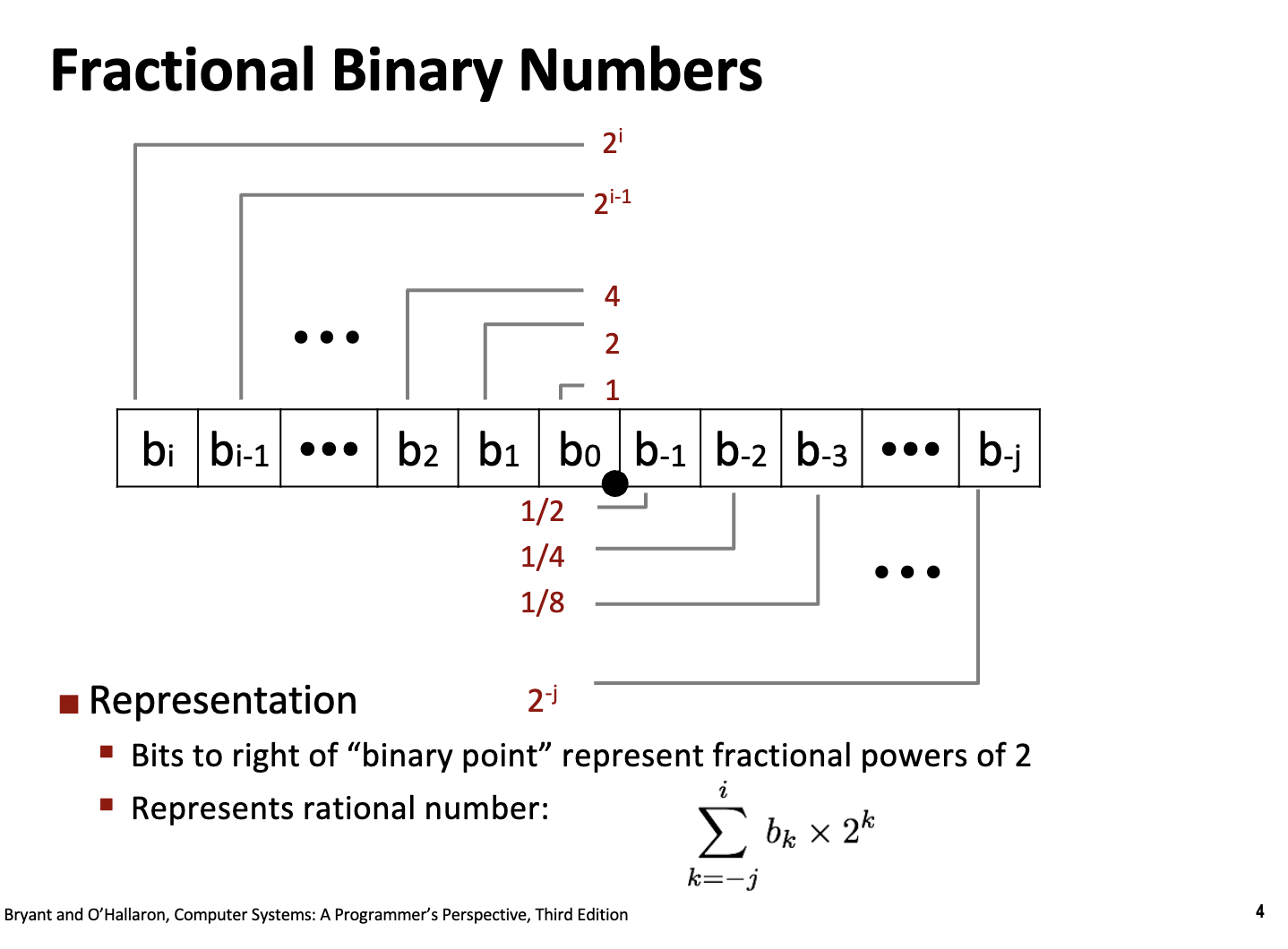
For example, 0.11111111 = 1.0 - $\epsilon$
Limitations
- 在十进制中很多有限小数和无限小数都需要被解释成无限循环小数,这会产生截断误差:
#include <stdio.h>

void paradox() {
  double x = 0.1f;
  double y = 0.2f;
  double z = 0.3f;

  printf("The sum of 0.1 + 0.2:\t%.20f\n", x + y);
  printf("The value of 0.3:\t%.20f\n", z);
  printf("Are they the same? ");
  printf((x + y == z ? "True" : "False"));
  printf("\n");
}

int main(){
    paradox();
}
The sum of 0.1 + 0.2:   0.30000000447034835815
The value of 0.3:       0.30000001192092895508
Are they the same? False
- precision 和 data range 是一对 trade-off,在单个数值的字长有限的情况下,计算机需要更多的小数位数来表示精确的数值,而需要更多的整数位数来表示更大的数据
IEEE Floating Points
符号位,指数部分和尾数部分:
\[(-1)^s \times M \times 2^E\]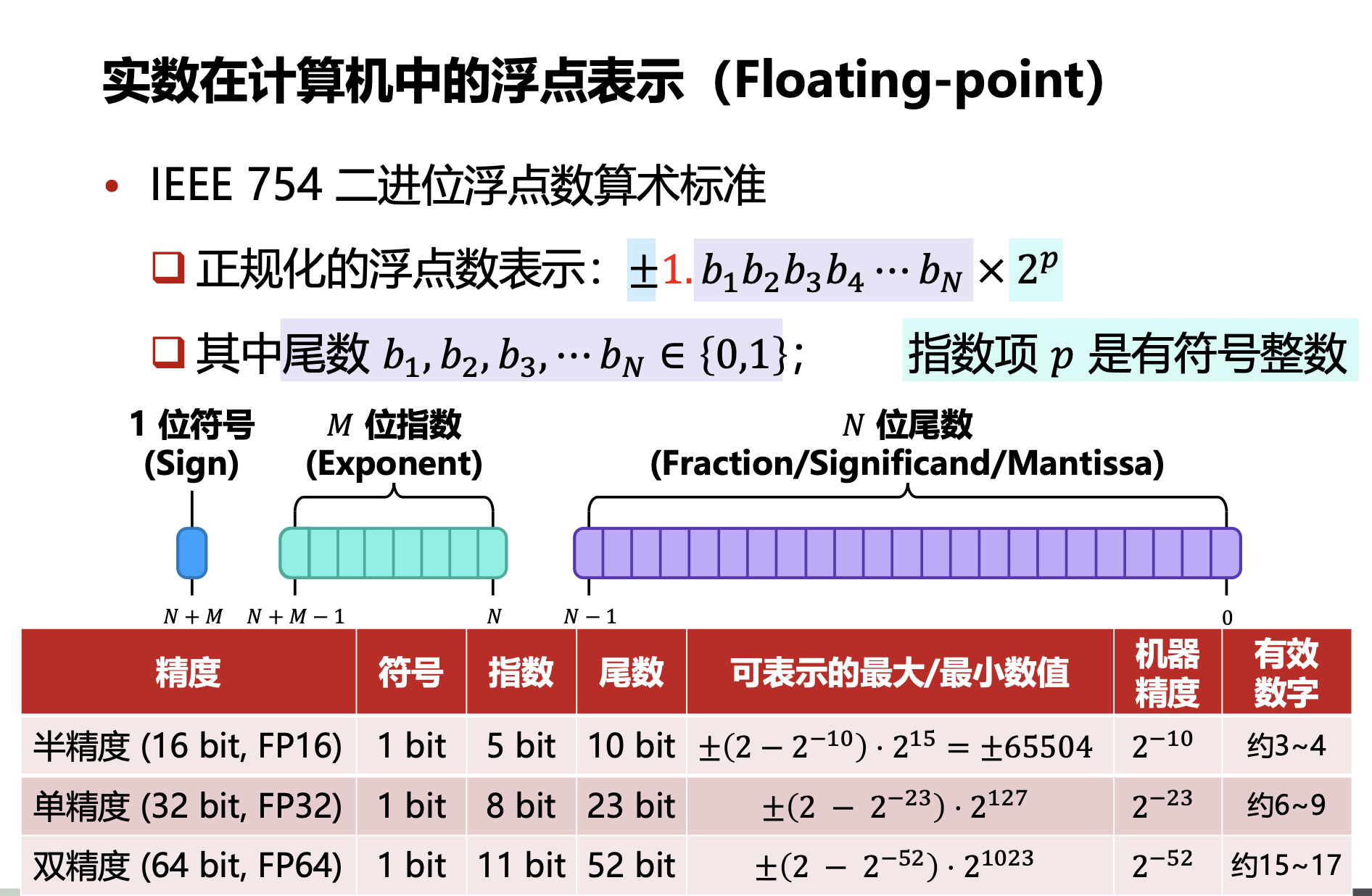
Normalized Values
在上述的计数标准中,指数部分 $E$ 为一个有符号整数,假设一个浮点数中分配了 $M$ 位的字长给指数部分,则此时指数部分可以表示的大小为:$E \in [-2^{M-1} + 2, 2^{M-1} - 1]$
$-2^{M-1}$ 和 $-2^{M-1} + 1$ 用于表示特殊的类型
此时指数部分 $E$ 的存储方式是补码形式存储有符号整数,此时因为首位符号位的权重为负数,不方便比较大小,因此选择将有符号整数加上指数偏置变成无符号整数。加上的项为 $2^{M-1} -1$ 后 $E’ \in [1, 2^{M} - 2]$
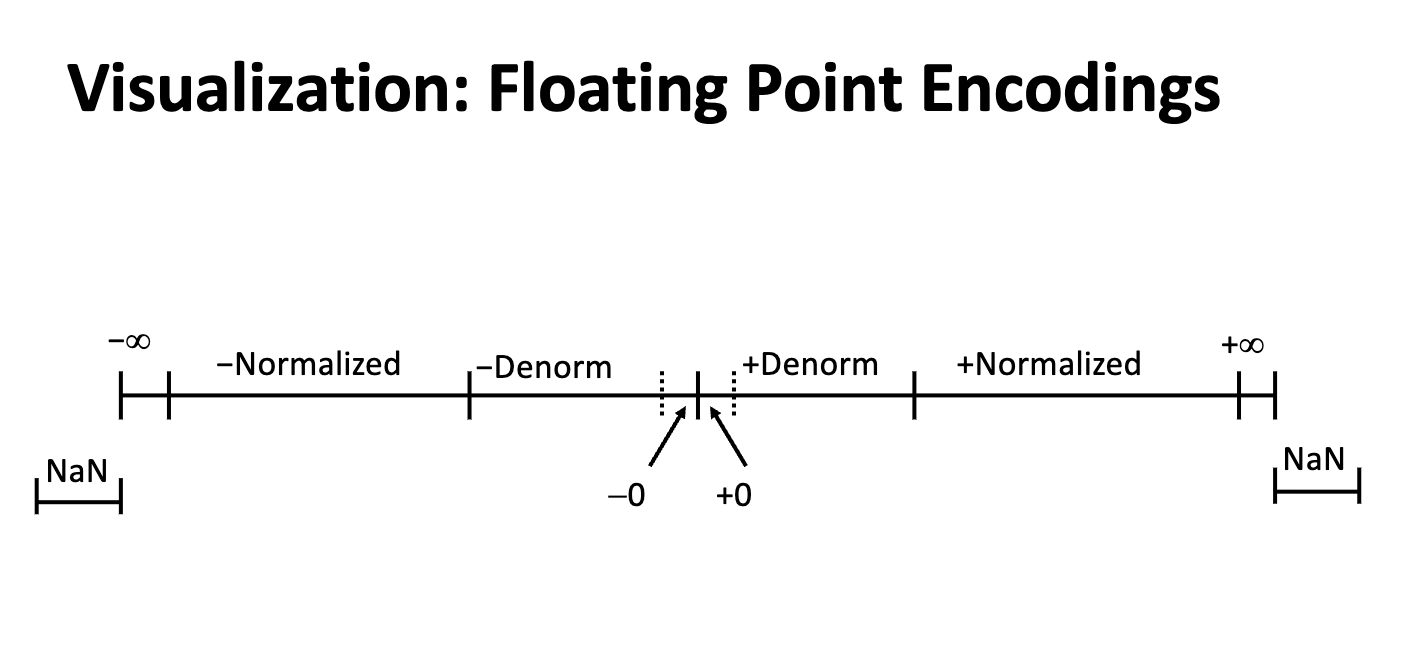
归一化后 $E’ = 0$ 和 $E’ = 2^M - 1$(-1 转化为无符号整数会自动到最大值),专门用于处理不正常的情况。
Denormalized Values
Condition: exp = 0000...00 (All zeros, $E’ = 0$)
Exponent Value: E = 1 - Bias
如果去掉归一化的项 $2^{M-1} -1$,对应的指数退回到有符号表示就是 $-2^{M-1} +1$,这代表这最小的指数位的情况(一个非常小的小数)。如果需要表示的数比这个数小,浮点数的值就会突越到 0,导致数值误差。
因此,为了实现极小数的平滑过渡,我们引入非规格化数 (Denormalized Values),对应的条件是 exp = 0000...00 并且尾数位的首位是 0,来表示更小的数字。
For normalized values, the actual floating pointing is:
\[V = (-1)^s \times (\mathbf{1}.f) \times 2^{E-2^{M-1}+1}\]For denormalized values, the actual floating point is:
\[V = (-1)^s \times (\mathbf{0}.f) \times 2^{-2^{M-1}+1}\]可以做一个非常粗浅的计算,计算如果不使用非规格化数最终计算绝对值最小的非零浮点数值:
- 不使用非规格化数:
- 使用规格化数:
为什么需要使用
E = 1 - Bias? 同样的,为了防止出现突然的断层:
- 如果使用
E = 1 - Bias
- 最大的非规格化数(尾数全为 1):$(0.111\dots1)_2 \times 2^{-126}$这个值无限接近于 $1.0 \times 2^{-126}$。
- 最小的规格化数:$(1.000\dots0)_2 \times 2^{-126}$
- 如果使用
E = 0 - Bias
- 最大的非规格化数(尾数全为 1):$(0.111\dots1)_2 \times 2^{-127} \approx 1.0 \times 2^{-1} \times 2^{-127} = \mathbf{1.0 \times 2^{-128}}$
- 最小的规格化数($E’=1$):$(1.000\dots0)_2 \times 2^{1-127} = \mathbf{1.0 \times 2^{-126}}$
- 两者存在 4 倍的偏差,此时浮点数的表示存在真空地带。
因此,IEEE-754 标准下的浮点数 ($M$ 位指数, $N$ 位尾数),可以近似连续的表示 $[2^{-2^{M-1} + 2 - N}, (2 - 2^{-N}) \times 2^{2^{M-1} - 1}]$ 范围内的浮点数值。
考虑符号位都是 0
在 IEEE 754 规格化数中,要取到最大正值,各部分的取值如下:
- 符号位 (S):0(代表正数)。
- 阶码位 (Exp):不能全为 1(因为全 1 预留给了 $\infty$ 和 NaN)。所以阶码的最大值是 全 1 减 1。二进制表示:$111\dots10$,数值 $E’$:$2^M - 2$
- 尾数位 (Fraction):全为 1。二进制表示:$1.11\dots1$,数值:$1 + (1 - 2^{-N})$
根据规格化数的求和公式 $V = (1 + f) \times 2^{E’ - Bias}$:
-
实际指数 (E):\(E = E'_{max} - Bias = (2^M - 2) - (2^{M-1} - 1)\)\(E = 2^{M-1} - 1\)
-
尾数 (1+f):当 $N$ 位尾数全为 1 时,其值为:\(1 + \sum_{i=1}^{N} 2^{-i} = 1 + (1 - 2^{-N}) = 2 - 2^{-N}\)
最终最大值 $V_{max}$:\(V_{max} = (2 - 2^{-N}) \times 2^{2^{M-1} - 1}\)
Special Values
Condition: exp = 1111...11 (All ones, $E’ = 2^M - 1$)
exp = 111...1,frac=000...0: $\infin$- 代表正无穷 & 负无穷
exp = 111...1,frac=000...0: NaN (Not a Number)- 状态传播(Pollution):NaN 具有“传染性”。一旦你的计算中出现了一个 NaN,任何涉及它的后续运算(如 NaN + 5)结果都会是 NaN。
- 同样,这些未定义的浮点数编码结果也可以用来实现 Nan Payload。
Dynamic Ranges
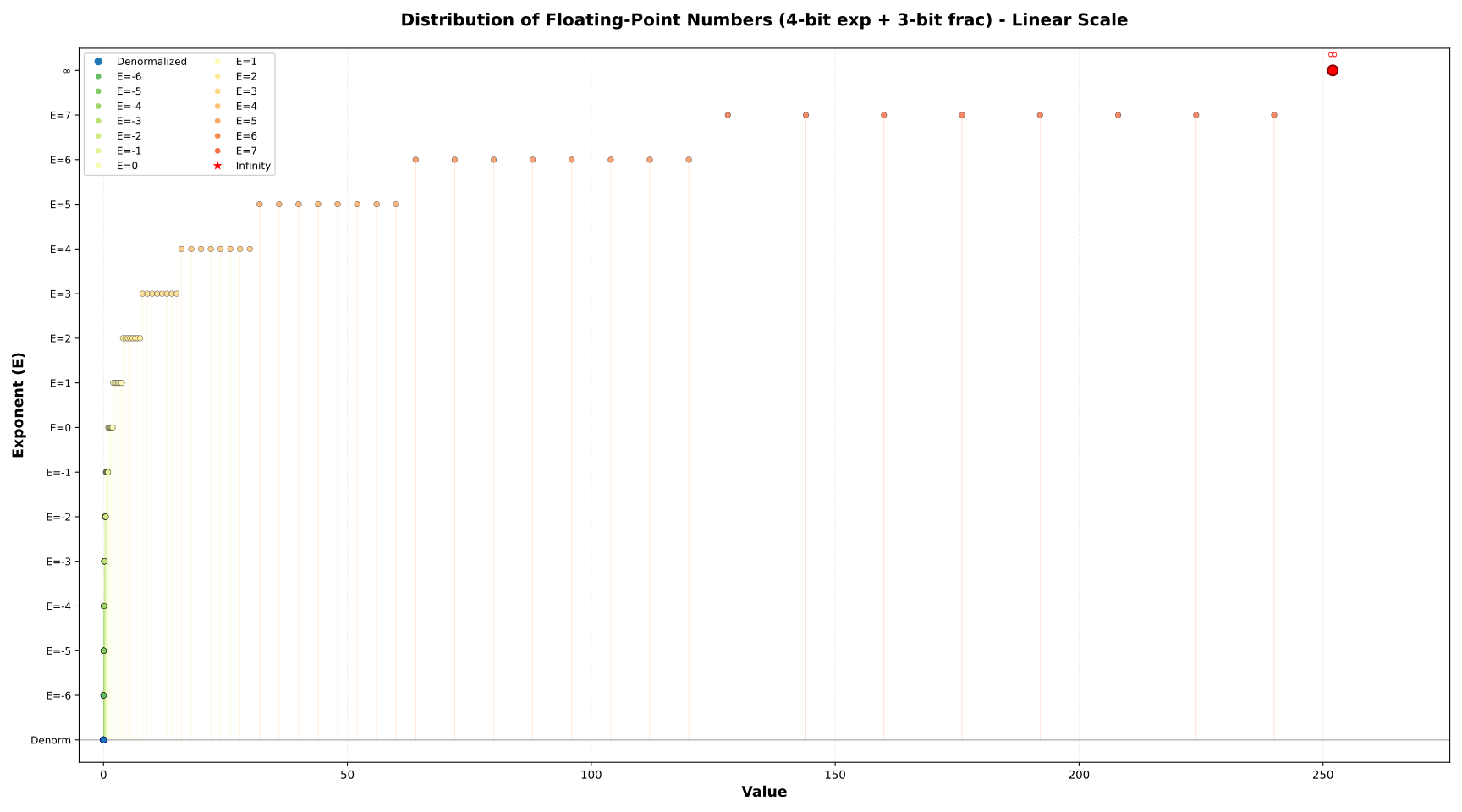
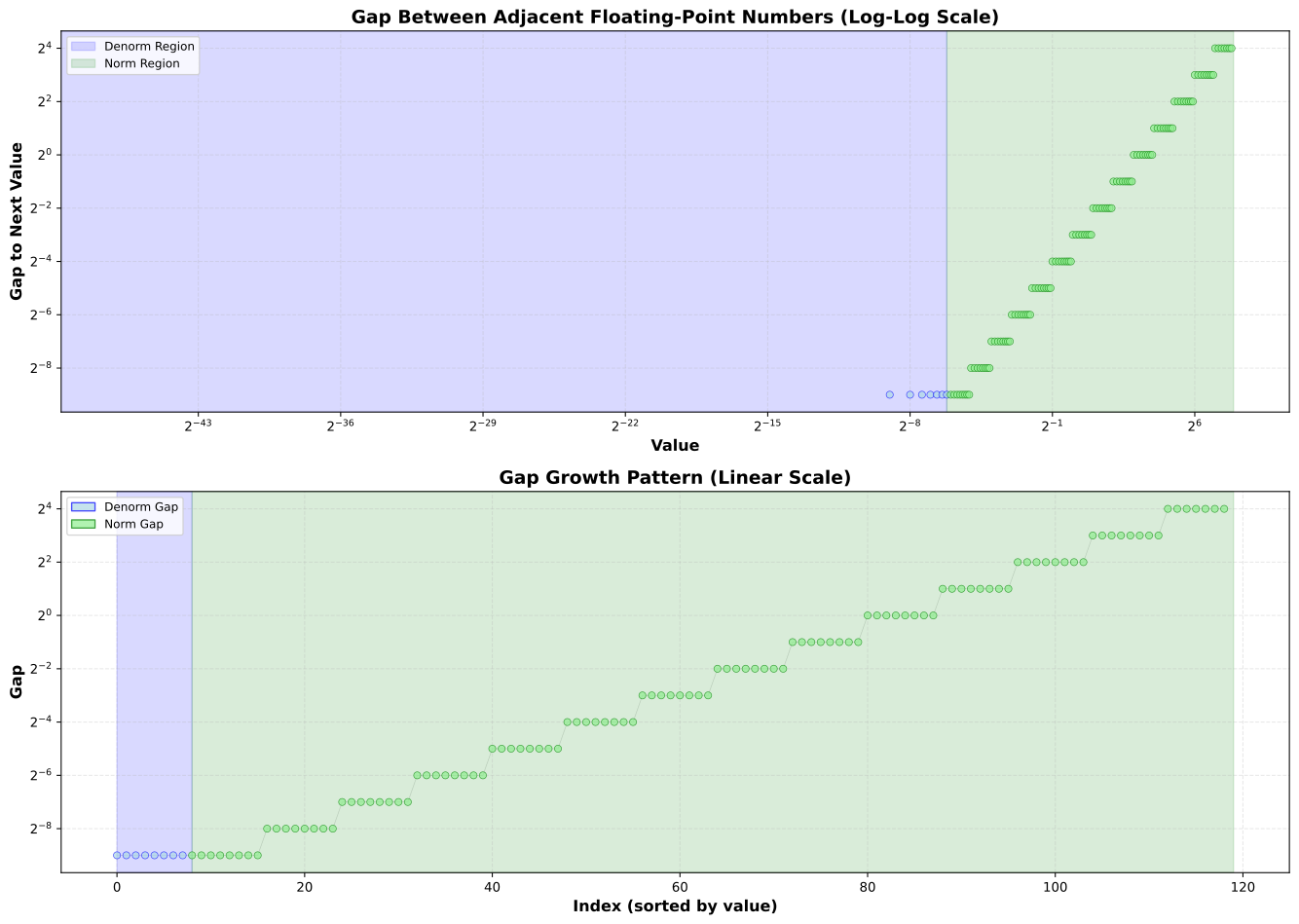
假设指数位为 4 位,尾数位为 3 位,则简易的浮点数可以表示为:
Full Floating-Point Representation Table
```text Floating-Point Representation Table (4 exponent bits + 3 fraction bits) ========================================================================================== s exp frac E Fraction Category ------------------------------------------------------------------------------------------ 0 0000 000 -6 0 Denormalized 0 0000 001 -6 1/512 Denormalized 0 0000 010 -6 1/256 Denormalized 0 0000 011 -6 3/512 Denormalized 0 0000 100 -6 1/128 Denormalized 0 0000 101 -6 5/512 Denormalized 0 0000 110 -6 3/256 Denormalized 0 0000 111 -6 7/512 Denormalized 0 0001 000 -6 1/64 Normalized 0 0001 001 -6 9/512 Normalized 0 0001 010 -6 5/256 Normalized 0 0001 011 -6 11/512 Normalized 0 0001 100 -6 3/128 Normalized 0 0001 101 -6 13/512 Normalized 0 0001 110 -6 7/256 Normalized 0 0001 111 -6 15/512 Normalized 0 0010 000 -5 1/32 Normalized 0 0010 001 -5 9/256 Normalized 0 0010 010 -5 5/128 Normalized 0 0010 011 -5 11/256 Normalized 0 0010 100 -5 3/64 Normalized 0 0010 101 -5 13/256 Normalized 0 0010 110 -5 7/128 Normalized 0 0010 111 -5 15/256 Normalized 0 0011 000 -4 1/16 Normalized 0 0011 001 -4 9/128 Normalized 0 0011 010 -4 5/64 Normalized 0 0011 011 -4 11/128 Normalized 0 0011 100 -4 3/32 Normalized 0 0011 101 -4 13/128 Normalized 0 0011 110 -4 7/64 Normalized 0 0011 111 -4 15/128 Normalized 0 0100 000 -3 1/8 Normalized 0 0100 001 -3 9/64 Normalized 0 0100 010 -3 5/32 Normalized 0 0100 011 -3 11/64 Normalized 0 0100 100 -3 3/16 Normalized 0 0100 101 -3 13/64 Normalized 0 0100 110 -3 7/32 Normalized 0 0100 111 -3 15/64 Normalized 0 0101 000 -2 1/4 Normalized 0 0101 001 -2 9/32 Normalized 0 0101 010 -2 5/16 Normalized 0 0101 011 -2 11/32 Normalized 0 0101 100 -2 3/8 Normalized 0 0101 101 -2 13/32 Normalized 0 0101 110 -2 7/16 Normalized 0 0101 111 -2 15/32 Normalized 0 0110 000 -1 1/2 Normalized 0 0110 001 -1 9/16 Normalized 0 0110 010 -1 5/8 Normalized 0 0110 011 -1 11/16 Normalized 0 0110 100 -1 3/4 Normalized 0 0110 101 -1 13/16 Normalized 0 0110 110 -1 7/8 Normalized 0 0110 111 -1 15/16 Normalized 0 0111 000 0 1 Normalized 0 0111 001 0 9/8 Normalized 0 0111 010 0 5/4 Normalized 0 0111 011 0 11/8 Normalized 0 0111 100 0 3/2 Normalized 0 0111 101 0 13/8 Normalized 0 0111 110 0 7/4 Normalized 0 0111 111 0 15/8 Normalized 0 1000 000 1 2 Normalized 0 1000 001 1 9/4 Normalized 0 1000 010 1 5/2 Normalized 0 1000 011 1 11/4 Normalized 0 1000 100 1 3 Normalized 0 1000 101 1 13/4 Normalized 0 1000 110 1 7/2 Normalized 0 1000 111 1 15/4 Normalized 0 1001 000 2 4 Normalized 0 1001 001 2 9/2 Normalized 0 1001 010 2 5 Normalized 0 1001 011 2 11/2 Normalized 0 1001 100 2 6 Normalized 0 1001 101 2 13/2 Normalized 0 1001 110 2 7 Normalized 0 1001 111 2 15/2 Normalized 0 1010 000 3 8 Normalized 0 1010 001 3 9 Normalized 0 1010 010 3 10 Normalized 0 1010 011 3 11 Normalized 0 1010 100 3 12 Normalized 0 1010 101 3 13 Normalized 0 1010 110 3 14 Normalized 0 1010 111 3 15 Normalized 0 1011 000 4 16 Normalized 0 1011 001 4 18 Normalized 0 1011 010 4 20 Normalized 0 1011 011 4 22 Normalized 0 1011 100 4 24 Normalized 0 1011 101 4 26 Normalized 0 1011 110 4 28 Normalized 0 1011 111 4 30 Normalized 0 1100 000 5 32 Normalized 0 1100 001 5 36 Normalized 0 1100 010 5 40 Normalized 0 1100 011 5 44 Normalized 0 1100 100 5 48 Normalized 0 1100 101 5 52 Normalized 0 1100 110 5 56 Normalized 0 1100 111 5 60 Normalized 0 1101 000 6 64 Normalized 0 1101 001 6 72 Normalized 0 1101 010 6 80 Normalized 0 1101 011 6 88 Normalized 0 1101 100 6 96 Normalized 0 1101 101 6 104 Normalized 0 1101 110 6 112 Normalized 0 1101 111 6 120 Normalized 0 1110 000 7 128 Normalized 0 1110 001 7 144 Normalized 0 1110 010 7 160 Normalized 0 1110 011 7 176 Normalized 0 1110 100 7 192 Normalized 0 1110 101 7 208 Normalized 0 1110 110 7 224 Normalized 0 1110 111 7 240 Normalized 0 1111 000 N/A Infinity Infinity ========================================================================================== Statistics: Denormalized numbers: 8 Normalized numbers: 112 Infinity: 1 Total: 121 ========================================================================================== ```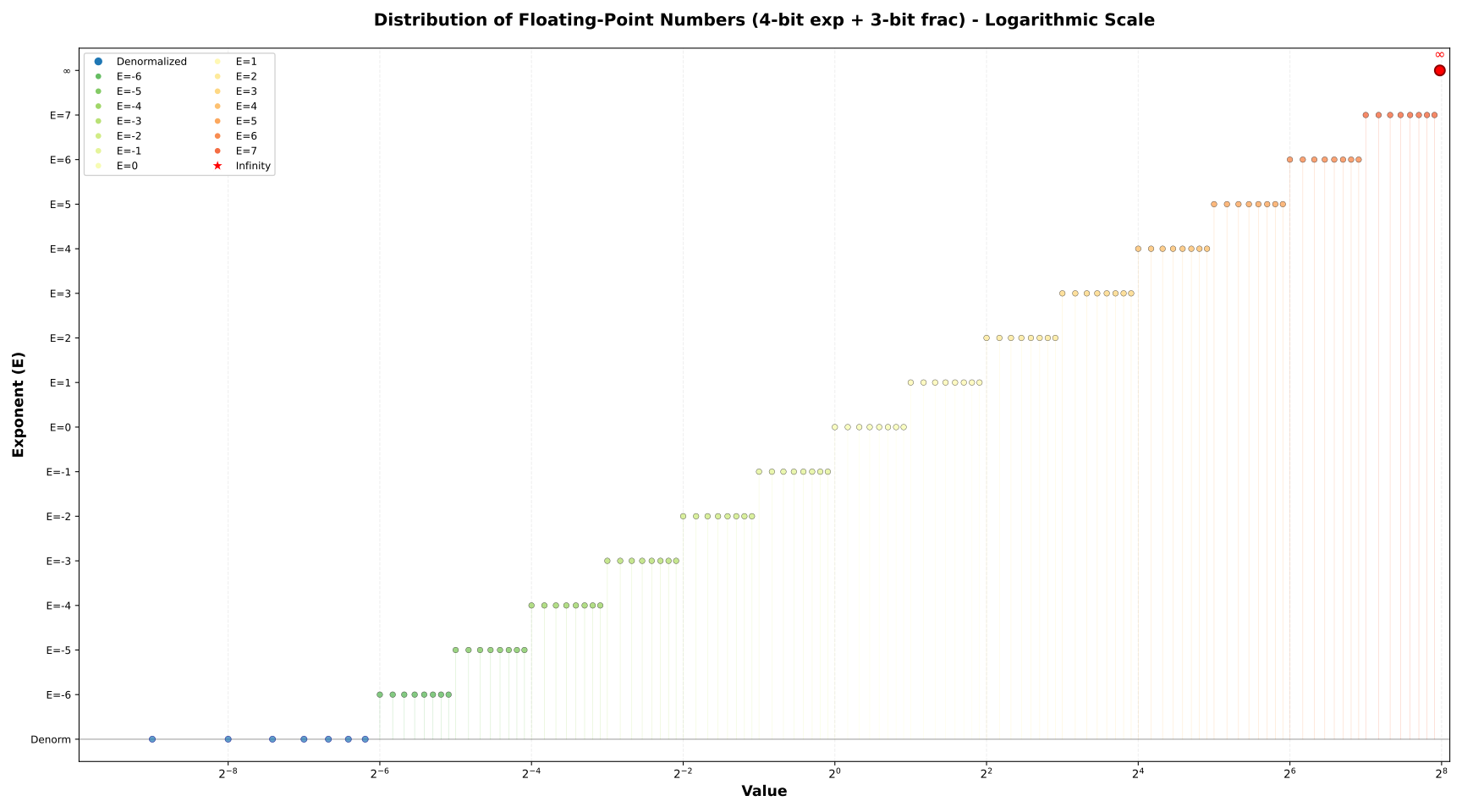
Rounding, Addition and Multiplications
Basic Idea
- First compute exact result (assume infinite bits)
- Use rounding to make the computation available.
- Possibly Overflow
- Possibly round to fit into
frac
Rounding
舍入是一个非常深入的哲学命题,对于有限字长的计算机而言,舍入操作是必要的,也必定会带来微小误差。舍入存在不同的方式:
- Towards Zero
- Round Up ($\infin$)
- Round Down ($-\infin$)
- Nearest Even (default)
Towards Zero Rounding
- 逻辑:直接截断。不管正负,只保留能存下的位。
- 直观理解:正数变小,负数变大(向坐标轴原点靠拢)。
- 例子:$1.9 \rightarrow 1$,$ -1.9 \rightarrow -1$。
- 用途:C 语言中 (int) 强制类型转换的默认行为。
Round Up Rounding
- 逻辑:结果总是取右侧最近的可表示数。
- 直观理解:像天花板一样,往“大”的方向走。
- 例子:,$ -1.9 \rightarrow -1$。
- 用途:常用于区间算术,确保计算结果的上限是安全的。
Round Down Rounding
- 逻辑:结果总是取左侧最近的可表示数。
- 直观理解:像地板一样,往“小”的方向走。
- 例子:,$ -1.1 \rightarrow -2$。
- 用途:确保计算结果的下限是安全的。
Nearest Even Rounding (Round to Nearest, Ties to Even)
IEEE 754 的默认模式。
- 基本逻辑:哪边近就往哪边舍 (Round Up/Round Down)。
- 特殊情况(Ties):如果刚好在两个数的中点(比如十进制的 $0.5$),选择末尾是偶数的那一边。(四舍六入五留双)
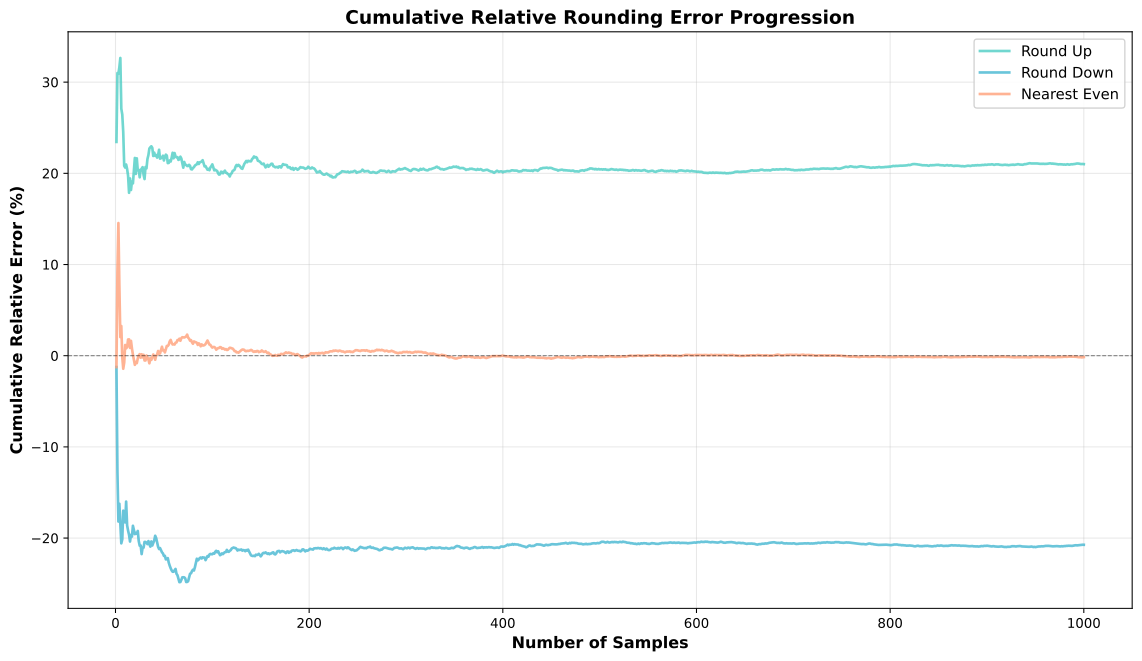
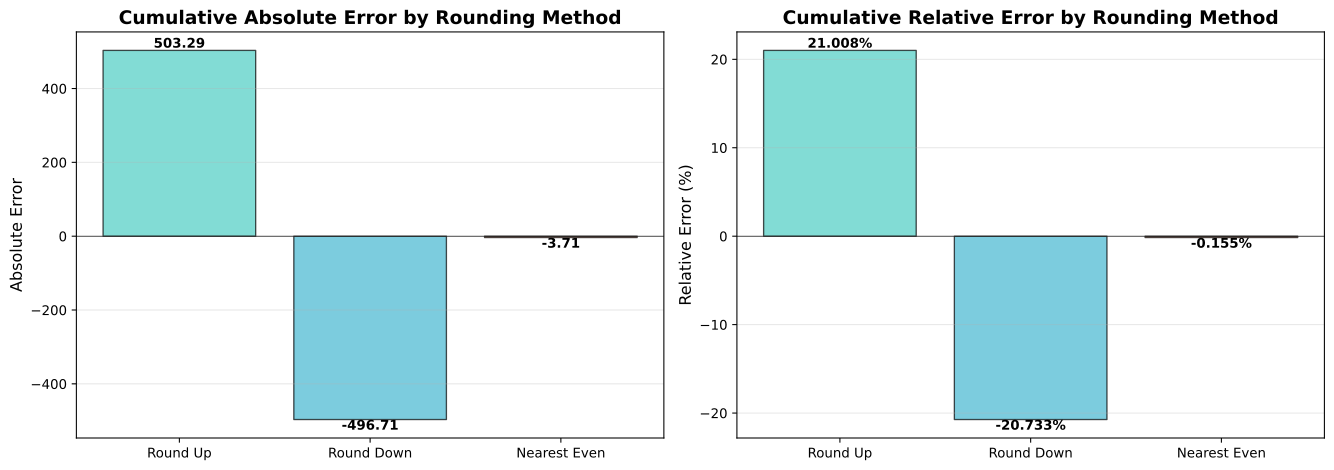
- 如果一律“逢五进一”,在大量计算后,误差会累积偏大。一半时间向后舍,一半时间向前入(偶数分布是均匀的),统计学上的误差总和趋近于 0。
Rounding Binary Numbers
对于二进制,需要找到两个数的中点并进行判断:
例如,10.00011 需要舍入到小数点后两位 (10.00 & 10.01):
- Getting the average:
10.001 10.00011is smaller than10.00011, thus round down to10.0010.00110is bigger than10.00011, thus round up to10.0110.11100: compare with10.11and11.00, the medium number is10.111. 此时需要选择末尾是偶数(0) 的那一边,即11.00(round up)10.10100: compare with10.10and10.11, the medium number is10.101, 此时需要选择末尾是偶数(0) 的那一边,即10.10(round down)
从统计学上,如此的舍入方式可以很好的减少舍入误差,我们也可以做一个模拟实验展示 Round Up, Round Down, Nearest Even Rounding 三种不同的舍入方式:
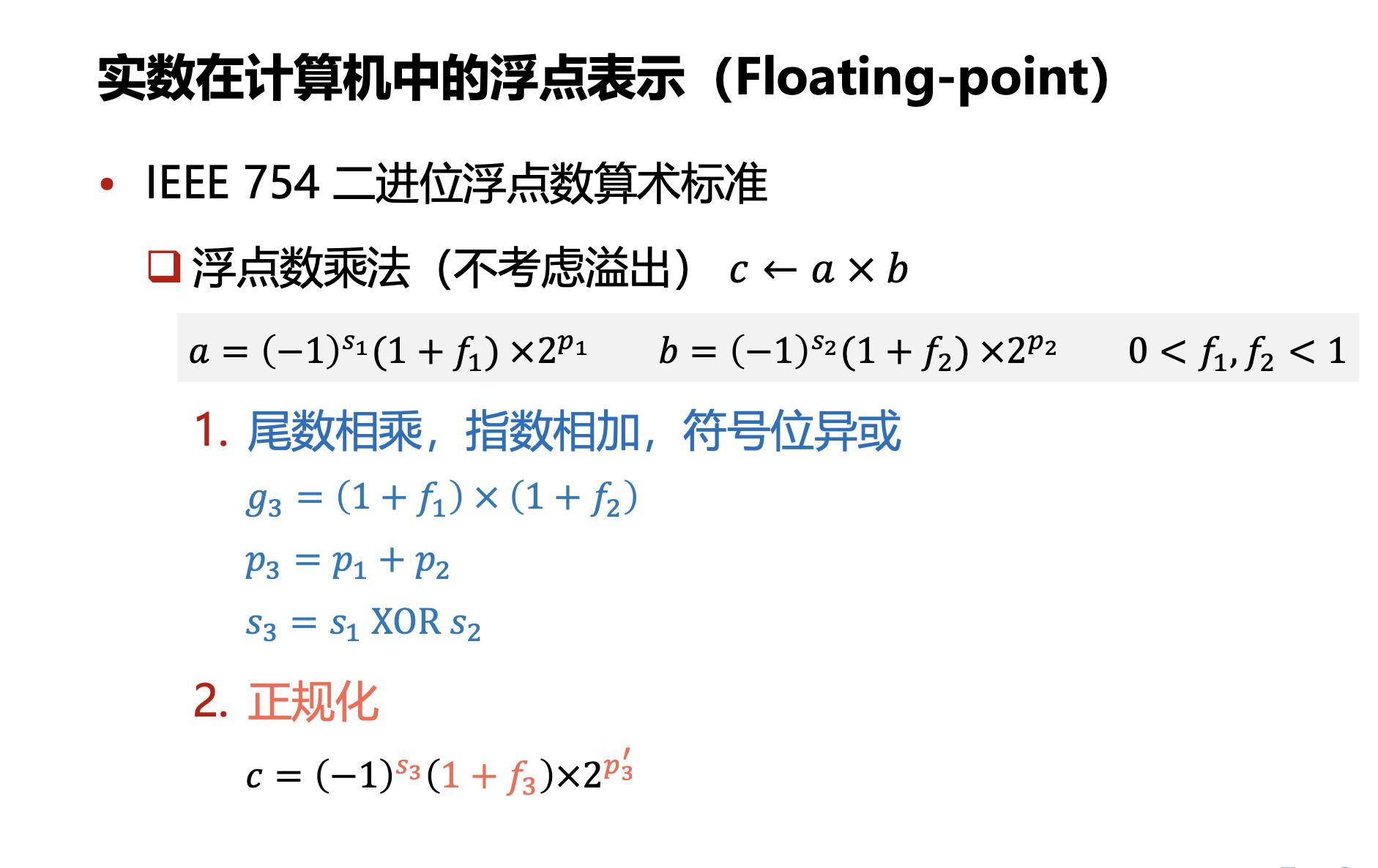
Floating Point Multiplications
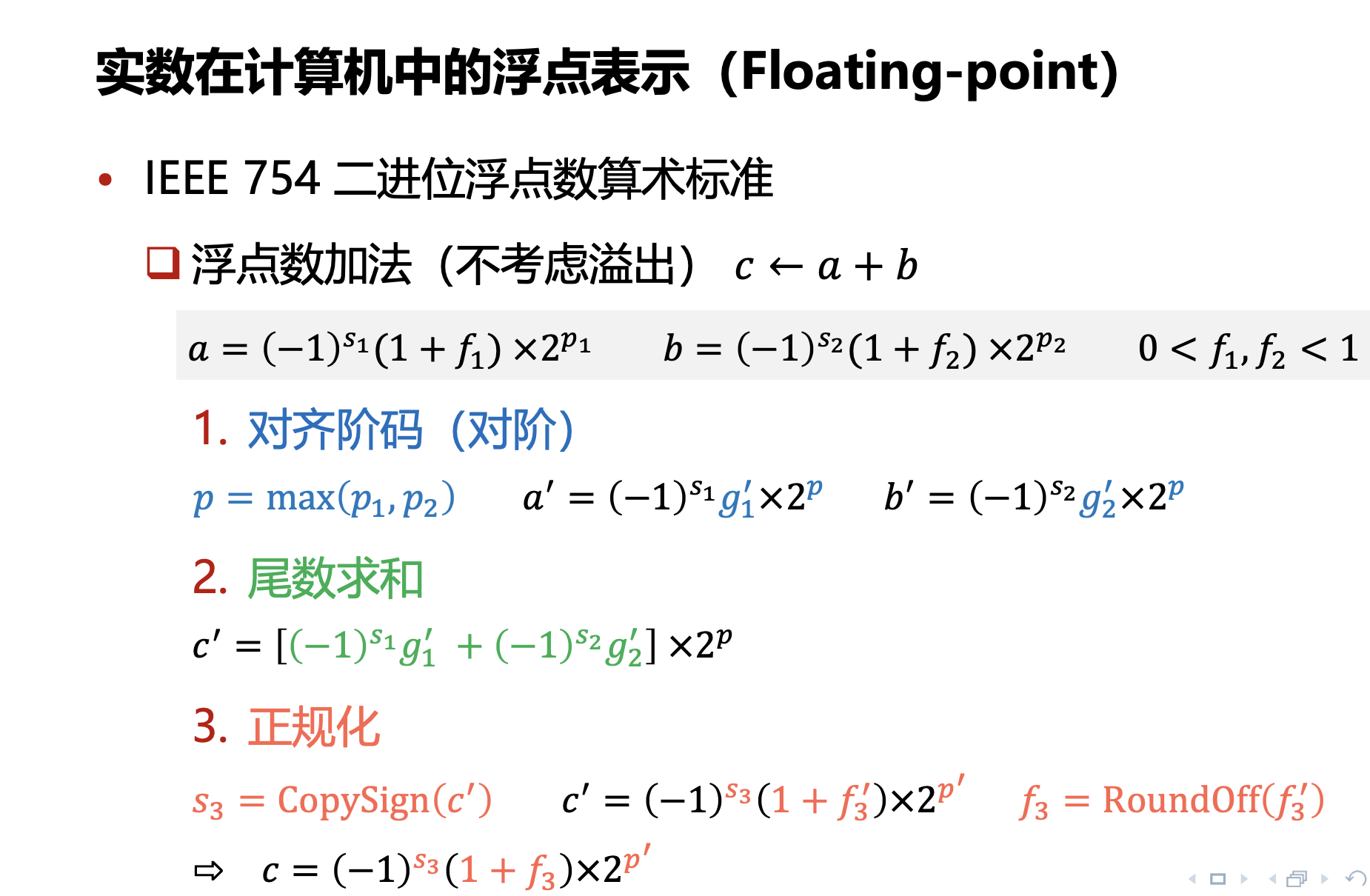
Floating Point Addition
-
对齐阶码是为了保证指数位是相同的,此时指数部分更小的数的尾数部分会发生右移位操作(移位的目标是对齐到两个指数到其最大值),此时会发生截断误差。
-
对齐阶码后,尾数部分进行求和,具体的求和过程本质上就是无符号整数的求和过程。
-
接下来,对浮点数的运算结果进行正规化操作(保证其符合浮点数的形式),此时也会发生因为移位而导致的截断误差。
-
最终会进行舍入操作,将超过位数的部分通过 Round 的方式进行舍入。(为了保证精度,当 CPU 的算术逻辑单元(ALU)处理尾数相加时,它不会只用 23 位(float)来算。它会在右侧增加三个额外的位,这就是 GRS 位)
Mathematical Properties for Floating Point Additions
- 满足交换律
- 不满足结合律(考虑舍入误差)
Floating Point in C
float and double
Conversions and Castings
Casting between int, float, and double changes bit representation.
double/floatintoint:- truncate fractional part rounding towards zero.
- UB when out of range or NaN, always sets to TMIN.
intintodouble:- as long as
inthas less than 53 bit word size. (e.g.int64will fail)
- as long as
intintofloat:- as long as
inthas less than 23 bit word size. (int32andint64will fail)
- as long as
#include <stdio.h>
#include <limits.h>
#include <math.h>

void show_casting(){
    // Casting between `int`, `float`, and `double` changes bit representation.

    // 1. double/float into int: truncate fractional part (rounding towards zero)
    printf("1. double/float to int (truncate towards zero):\n");
    double d1 = 3.7;
    double d2 = -3.7;
    float f1 = 2.9f;
    float f2 = -2.9f;

    printf("   double 3.7 -> int: %d\n", (int)d1);
    printf("   double -3.7 -> int: %d\n", (int)d2);
    printf("   float 2.9 -> int: %d\n", (int)f1);
    printf("   float -2.9 -> int: %d\n", (int)f2);

    // Overflow case: out of range sets to INT_MIN (undefined behavior)
    double d_overflow = 1.0e100;
    int i_overflow = (int)d_overflow;
    printf("   double 1e100 -> int: %d (overflow, UB)\n", i_overflow);

    // NaN case: NaN sets to INT_MIN (undefined behavior)
    double d_nan = NAN;
    int i_nan = (int)d_nan;
    printf("   double NaN -> int: %d (0, UB)\n\n", i_nan);

    // 2. int into double: works as long as int has less than 53 bit word size
    printf("2. int to double (works for < 53 bits):\n");
    int i1 = 123456789;
    long long ll_large = 9007199254740992LL;  // 2^53, boundary case

    double d_from_int = (double)i1;
    double d_from_ll = (double)ll_large;

    printf("   int 123456789 -> double: %.0f (exact)\n", d_from_int);
    printf("   int64 2^53 -> double: %.0f\n", d_from_ll);

    long long ll_very_large = 9007199254740993LL;  // 2^53 + 1
    double d_very_large = (double)ll_very_large;
    printf("   int64 (2^53+1) -> double: %.0f\n\n", d_very_large);

    // 3. int into float: works as long as int has less than 23 bit word size
    printf("3. int to float (works for < 23 bits):\n");
    int i2 = 1000000;  // < 2^23, should work exactly
    int i_large = 16777216;  // 2^24, exceeds precision

    float f_from_int = (float)i2;
    float f_from_large = (float)i_large;

    printf("   int 1000000 -> float: %.0f (exact)\n", f_from_int);
    printf("   int 16777216 (2^24) -> float: %.0f\n", f_from_large);

    int i_very_large = 16777217;  // 2^24 + 1
    float f_very_large = (float)i_very_large;
    printf("   int 16777217 (2^24+1) -> float: %.0f\n", f_very_large);
}

int main() {
    show_casting();
    return 0;
}
1. double/float to int (truncate towards zero):
   double 3.7 -> int: 3
   double -3.7 -> int: -3
   float 2.9 -> int: 2
   float -2.9 -> int: -2
   double 1e100 -> int: 2147483647 (overflow, UB)
   double NaN -> int: 0 (0, UB)

2. int to double (works for < 53 bits):
   int 123456789 -> double: 123456789 (exact)
   int64 2^53 -> double: 9007199254740992
   int64 (2^53+1) -> double: 9007199254740992

3. int to float (works for < 23 bits):
   int 1000000 -> float: 1000000 (exact)
   int 16777216 (2^24) -> float: 16777216
   int 16777217 (2^24+1) -> float: 16777216
Mixed-Precision Training
>>> torch.finfo(torch.float16)
finfo(resolution=0.001, min=-65504, max=65504, eps=0.000976562, smallest_normal=6.10352e-05, tiny=6.10352e-05, dtype=float16)
>>> torch.finfo(torch.float32)
finfo(resolution=1e-06, min=-3.40282e+38, max=3.40282e+38, eps=1.19209e-07, smallest_normal=1.17549e-38, tiny=1.17549e-38, dtype=float32)
>>> torch.finfo(torch.float64)
finfo(resolution=1e-15, min=-1.79769e+308, max=1.79769e+308, eps=2.22045e-16, smallest_normal=2.22507e-308, tiny=2.22507e-308, dtype=float64)
>>> torch.finfo(torch.bfloat16)
finfo(resolution=0.01, min=-3.38953e+38, max=3.38953e+38, eps=0.0078125, smallest_normal=1.17549e-38, tiny=1.17549e-38, dtype=bfloat16)
- 原精度计算对 GPU 的显存要求极高
- 因为在训练阶段反向传播的过程中计算图的存储和计算需要占据额外的存储空间(相比于后续固定参数的推理阶段),因此为了保证显存的高效利用,提出了混合精度训练,核心目标是在保持相同性能的前提下进行混合精度训练。
- 直接使用 FP16 等精度更低的数字会导致严重的下溢出和数值计算的不稳定现象。
混合精度训练:使用FP16计算,使用FP32做模型权重更新
- 模型权重使用FP32存储
- 将模型权重从FP32转换为FP16
- 使用FP16进行前向计算,得到损失值(loss)
- 缩放损失值
- 使用FP16进行反向计算,得到FP16的模型梯度
- 将模型梯度从FP16转换为FP32
- FP32 模型梯度除以前面的缩放值
- 更新FP32的模型权重
这样有两个好处:
- 减少精度误差累计带来的影响:从权重中读取和更新权重都是 FP32 精度,因此梯度下降做权重更新的时候误差影响较小
- 因为梯度的绝对值的数量级可能远小于权重本身的数量级
- 缓解梯度下溢出的问题: Underflow Problems
- 损失值缩放的方法
- 增加 exp 域的位宽,使用 BF16 进行存储
IEEE-754 标准下的浮点数 ($M$ 位指数, $N$ 位尾数),可以近似连续的表示 $[2^{-2^{M-1} + 2 - N}, (2 - 2^{-N}) \times 2^{2^{M-1} - 1}]$ 范围内的浮点数值。
- M 增大, N 减小: 表示范围变大,但是两个数之间的 gap 会变大(尤其是大数之间),精度更低
- M 减小,N 增大:表示范围变小,但是精度更高
例如,BF16 的指数位比 FP16 的指数位多 3 个 bit,保证在整体维持低显存的条件下进一步降低精度,减少数值上溢和下溢的问题。
在实际运算中,对于一些需要高精度的操作内部(算子)还是需要高精度计算,例如 CrossEntropyLoss/LayerNorm/RMSNorm 等等。